Ask any business owner why they lost a tender, and you'll hear the same answer almost every time: "They must have bid lower than us."
It's the easiest explanation. It's also, more often than not, wrong.
Procurement teams don't just buy the cheapest option. They buy the response that proves competence, reliability, and fit. Businesses that lose winnable tenders usually don't lose on price at all. They lose before they even finish writing, or before they even find out the opportunity existed. If you've ever wondered why a company with weaker capabilities keeps winning contracts your business is clearly better suited for, the answer probably isn't in your pricing sheet. It's in your process.
The Silent Killer of Tender Success: It's Not Your Price
Most businesses treat tendering as a writing problem. They assume that if they lose, it's because the proposal wasn't persuasive enough, or the number wasn't competitive enough. So the fix becomes "write better" or "bid lower."
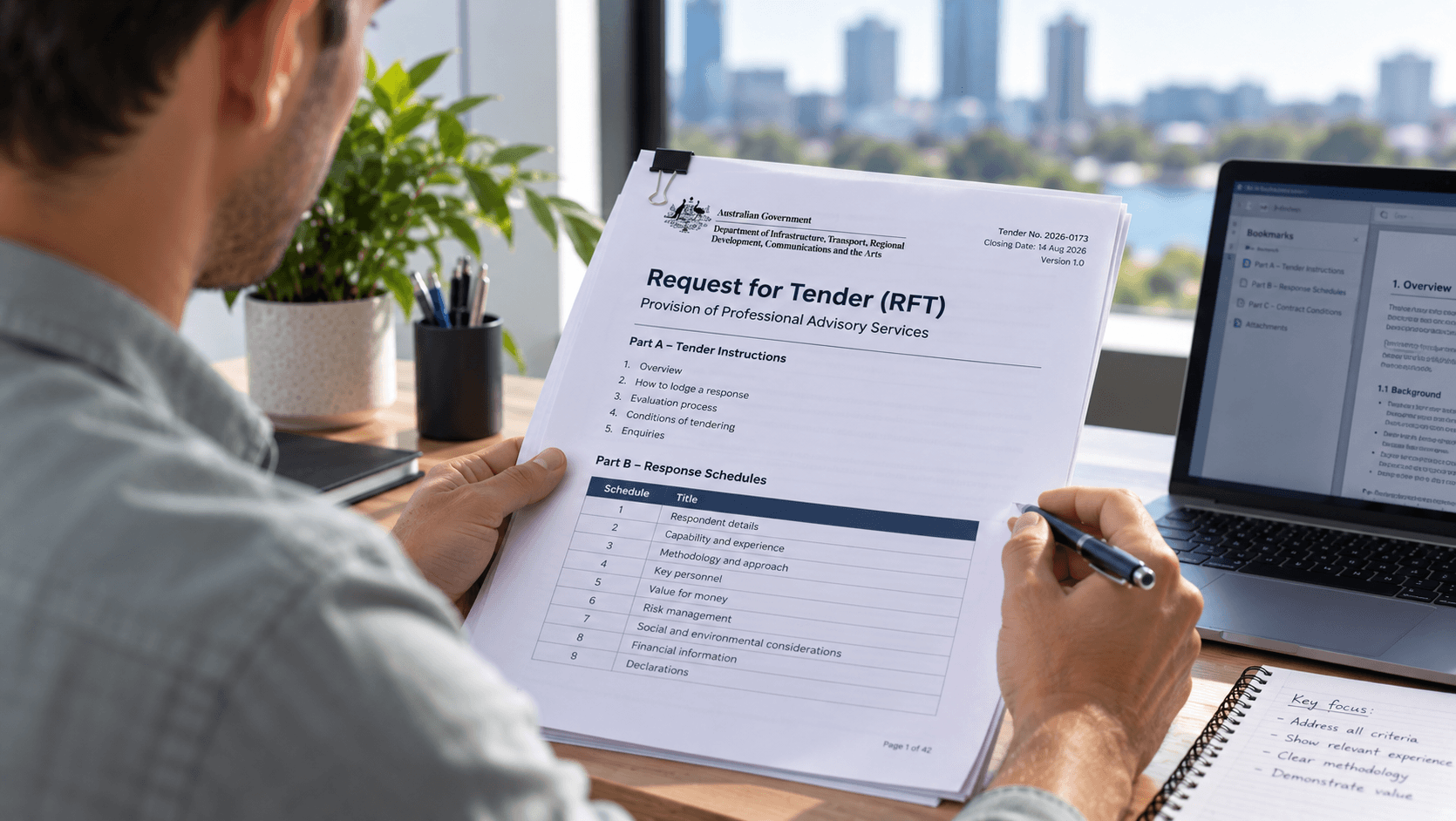
But talk to procurement evaluators, and a different picture emerges. Bids get disqualified or scored poorly for reasons that have nothing to do with price:
The response didn't address the evaluation criteria directly
It arrived rushed, generic, or clearly recycled from a previous submission
The business simply wasn't in the room, because they never saw the opportunity in time to prepare a serious response
Price is the tiebreaker. It's rarely the reason a tender is lost. The real losses happen earlier, in three quieter, less obvious places.
The Real Reasons Businesses Lose Winnable Tenders
1. You Never Saw the Tender
Tender notices don't live in one place. They're scattered across government portals, council websites, sector-specific platforms, and private buyer portals, each with different formats, login requirements, and publishing schedules. A business relying on manual searches or word-of-mouth is, by definition, only seeing a fraction of what's actually available.
This isn't a small gap. It's the difference between competing for contracts and not knowing they exist. A business could be perfectly positioned to win a tender and never even get the chance to try.
2. You Saw It Too Late
Even when a tender is spotted, timing kills more bids than bad writing ever does. Most public tenders give businesses two to four weeks to respond, but a real response needs research, internal sign-off, pricing calculations, document gathering, and multiple rounds of drafting.
Finding a tender with five days left on the clock doesn't leave room for a strong response. It leaves room for a rushed one. And evaluators can always tell the difference between a submission that was crafted and one that was assembled in a panic the night before the deadline.
3. Your Response Reads Like Everyone Else's
Tender evaluators read dozens of submissions per opportunity, often against a strict scoring rubric. A response that doesn't speak directly to each evaluation criterion, in the evaluator's language, not the applicant's, loses points regardless of how good the underlying business actually is.
Generic, copy-pasted answers are easy to spot. So are proposals that describe the company beautifully but never quite answer the specific question being asked. Evaluators aren't scoring your business. They're scoring your document.
4. You Physically Can't Write Enough of Them
Here's the constraint nobody talks about: tender writing is slow. A single quality response can take a small team days, sometimes over a week, of focused effort. If your business only has capacity to write two or three strong tenders a month, that's your entire ceiling for new contract revenue, no matter how many good-fit opportunities are out there.
Growth-focused businesses aren't usually limited by demand. They're limited by how many well-written applications they can physically produce before deadlines pass.
The Hidden Cost of Losing Tenders You Should Have Won
Each of these four gaps is invisible until you add them up. A missed opportunity doesn't show up as a loss on a scoreboard. It just never gets pursued. A late discovery doesn't get logged as a mistake. It just becomes "we didn't have time." A capacity ceiling doesn't feel like a problem. It feels like "we're just busy."
But the cumulative cost is real: fewer contracts won, slower revenue growth, and a business development team spending more time hunting for opportunities than actually writing winning responses. For businesses that depend on public or private tenders as a core revenue channel, this isn't a minor inefficiency. It's a ceiling on growth that has nothing to do with the quality of the work they'd actually deliver.
What Good Tender Management Actually Looks Like
Businesses that consistently win tenders, not occasionally, but consistently, tend to have three things in common:
Centralized, proactive discovery. They see relevant opportunities the moment they're published, filtered to their exact sector and capability, instead of searching manually across dozens of portals.
Enough lead time to write properly. Early discovery means early starts, which means responses that are researched and refined rather than rushed.
Capacity that scales with opportunity. Their ability to respond to tenders isn't capped by how many people they have free that week. They can produce more high-quality responses without burning out their team.
None of this requires being a bigger business. It requires a better system.
Closing the Gap
This is precisely the gap Tender Assist was built to close.
Instead of manually monitoring dozens of tender portals, Tender Assist's Finding Plans surface relevant opportunities as soon as they're published, filtered to match your sector and capability, so you're finding tenders on day one, not day ten.
And instead of your response quality and volume being capped by your team's writing bandwidth, Tender Assist helps you produce sharper, criteria-aligned responses faster, so a tight deadline doesn't automatically mean a weaker submission.
The businesses winning the contracts you should be winning usually aren't better than you. They're just finding opportunities earlier, and writing more responses without running out of time or people.
That's a fixable problem, not a pricing one.
Frequently asked questions
Why do businesses lose tenders even when their pricing is competitive?
Pricing is usually a tiebreaker, not the deciding factor. Most tenders are lost earlier, because the opportunity was found too late, the response didn't directly address the evaluation criteria, or the business ran out of time to submit a polished proposal. A competitive price can't save a response that arrives rushed or generic.
How do businesses miss tender opportunities they could have won?
Tenders are published across many separate portals, government sites, council pages, sector-specific platforms, and private buyer systems. Businesses relying on manual searches typically only see a fraction of what's actually live, so strong-fit opportunities often go unnoticed simply because no one was watching the right portal at the right time.
How much lead time is actually needed to write a strong tender response?
It varies by tender complexity, but most public tenders allow two to four weeks. A quality response needs time for research, internal sign-off, pricing, and multiple drafts, so finding a tender with only a few days left rarely leaves enough room to write a genuinely competitive submission.
Why do generic or templated tender responses score poorly?
Evaluators score submissions against a strict rubric tied to specific criteria. A response that doesn't speak directly to each requirement, even if the underlying business is strong, loses points. Evaluators are scoring the document in front of them, not the company's reputation.
What's the biggest hidden constraint on winning more tenders?
Writing capacity. A single strong response can take a team days to complete. If a business can only produce two or three quality submissions a month, that caps their contract-win potential regardless of how many good-fit tenders are actually out there.
Can technology actually fix these tender loss problems?
Yes, the two biggest gaps (missed discovery and limited writing capacity) are exactly what platforms like Tender Assist are built to solve. Automated, filtered tender alerts remove the discovery gap, and AI-assisted writing tools help teams produce more high-quality responses without adding headcount.
Ready to stop losing tenders to timing instead of talent? See how Tender Assist close the gap in your tender process.