How the Government Procurement Process Works in Australia
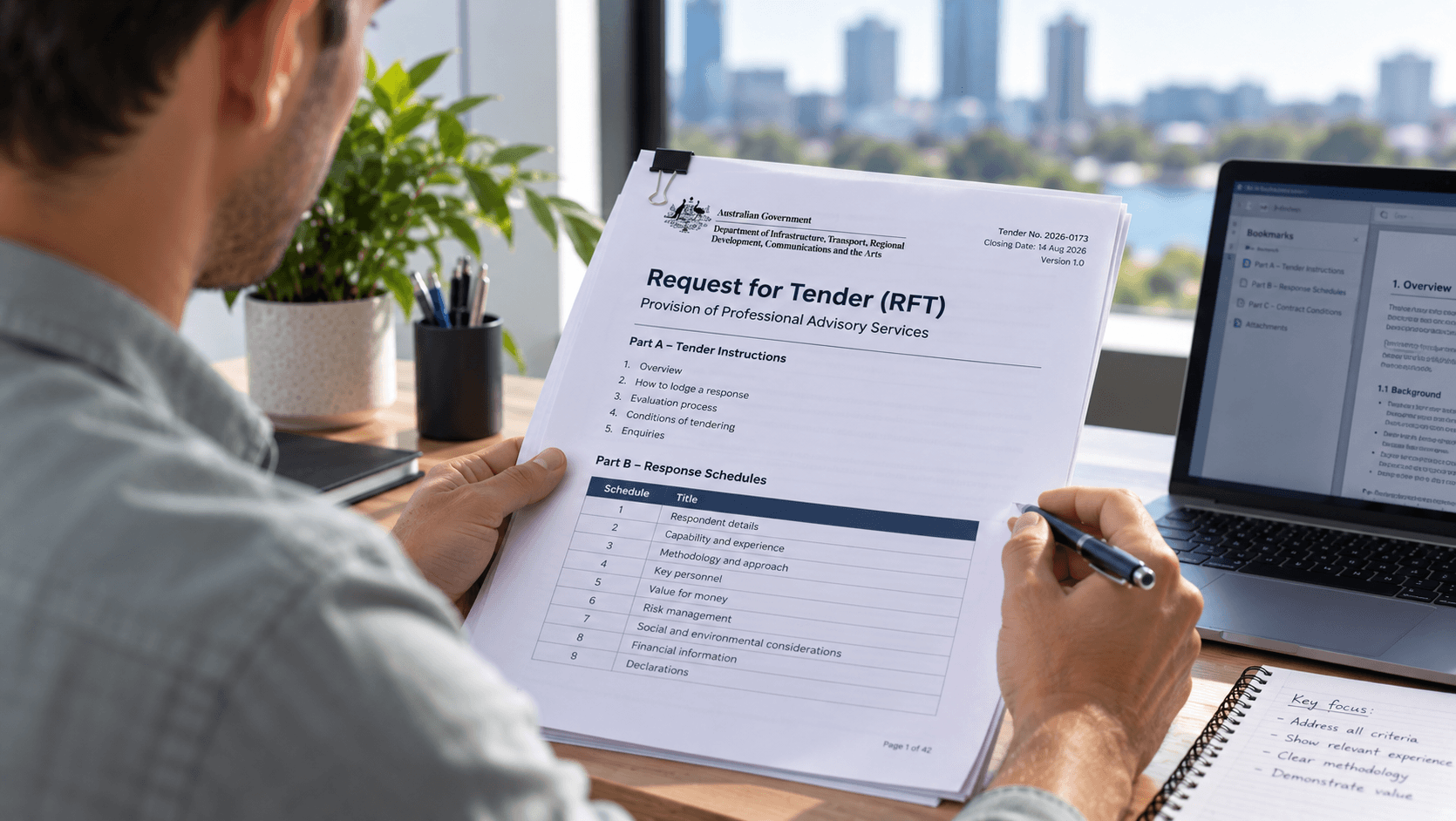
Australian government procurement, at federal, state, and local levels, follows a structured process designed to ensure fairness, transparency, and value for money. For small and medium businesses, understanding each stage is the foundation Of any successful bid. The process typically moves from a needs assessment by the agency, through market testing or a request for information, to a formal approach to market such as a Request for Tender (RFT), Request for Quote (RFQ), or Expression Of Interest (EOI). Knowing which instrument applies to your opportunity tells YOU a lot about what the buyer expects in return. At the federal level, the Commonwealth Procurement Rules (CPRs) govern how agencies spend public money. These rules set thresholds that determine when open tender is mandatory: currently $80,000 for most goods and services and $7.5 million for construction-related work. State governments operate under their own frameworks, such as Victoria's Social Procurement Framework or NSW's Procurement Policy Framework, each with their own thresholds and supplier registration requirements. If you are pursuing contracts across multiple jurisdictions, you need to be across the specific rules for each one, rather than assuming a one-size-fits-all approach For SMBs, the most practical entry points are panel arrangements, standing offers, and whole-of-government contracts. Being accepted onto a panel does not guarantee work, but it dramatically reduces the administrative burden each time an agency needs to engage you. Keeping your panel registrations current, including updated insurance certificates, financial statements, and capability statements, is ongoing compliance work that many small businesses underestimate until they miss a renewal deadline and find themselves off the list.
Decoding Tender Evaluation Criteria Before You Write a Word
Tender evaluation criteria in Australia are not a formality. They are the scoring sheet your response will be marked against, and the weighting assigned to each criterion tells you exactly where to spend your effort. Government tenders commonly use a weighted scoring model that separates price from non-price factors. Non-price criteria commonly include demonstrated experience, technical capability, methodology, key personnel, risk management, and in some cases local industry participation or social value commitments. If a criterion carries 30% Of the total score, your response to that criterion deserves 30% Of your writing time. A common mistake SMBs make is treating all criteria as narrative opportunities rather than evidence requirements. Australian government evaluators are trained to look for specific evidence: project examples with measurable outcomes, referee contact details, certifications, and process descriptions that match the scope Of works. Vague claims such as "we have extensive experience" without supporting specifics score poorly regardless Of how confident the writing sounds. Each criterion response should follow a clear structure: state your position, provide concrete evidence, and connect that evidence directly to the agency's need Many tender documents also include mandatory requirements: conditions that must be met before your response is even evaluated on merit. These are often listed separately from the scored criteria and can include insurance minimums, licences, security clearance levels, or financial thresholds. Failing to meet a single mandatory requirement typically results in automatic exclusion. Before you invest hours in writing, run through every mandatory requirement and confirm you can provide documented proof for each one.
Bid Management and Compliance Obligations During the Tender Period
Bid management for SMBs is as much about process discipline as it is about writing quality. A government tender has a fixed close date and time, typically lodged through a platform such as AusTender, Tenderlink, VendorPanel, or a state-equivalent portal, and late submissions are almost universally rejected. Building a submission timeline that works backwards from the lodgement deadline, with internal review milestones and sign-off checkpoints, is what separates businesses that consistently produce strong responses from those that rush the final document together the night before. Government procurement compliance during the tender period also means following the rules of the tender process itself. RFTs typically include a clause requiring that all clarification questions be submitted through a designated channel, usually the tender portal, by a specified date. Contacting the evaluation team directly or through personal relationships during the tender period can result in disqualification. If an addendum or clarification notice is issued by the agency, you are responsible for incorporating those changes into your response, even if you have already written a draft. Document management is another area where small businesses frequently run into trouble. Government tenders often require a specific file format, file size limit, naming convention, and page or word count per section. Submitting a PDF when a Word document was requested, or exceeding a page limit, can result in sections being disregarded. Keep a compliance checklist for every tender that maps each submission requirement to the relevant document or file in your response package. Reviewing this checklist on the day of lodgement, not the week before, is a practical habit that prevents avoidable errors.
Procurement Trends Shaping How Australian SMBs Win Government Work
Australian government procurement has shifted meaningfully in recent years in ways that directly affect SMB bidders. Social procurement is now embedded in tender requirements across many jurisdictions. The Victorian Social Procurement Framework, for instance, requires agencies to consider outcomes for Aboriginal and Torres Strait Islander businesses, businesses employing people with disability, and local suppliers when evaluating bids. The Buy Australian Plan at the federal level signals a sustained policy push toward domestic suppliers. For SMBs, this is an opportunity: if you can articulate your local workforce, local supply chain, or community impact, those attributes now carry real scoring weight in evaluation. Digital capability is another emerging differentiator. Agencies increasingly ask suppliers to describe how they use technology to deliver services, manage data securely, and report on outcomes. Even for trade-based or service businesses that are not technology companies, being able to demonstrate a structured approach to data handling, cybersecurity baseline compliance (such as alignment with the Australian Cyber Security Centre's Essential Eight), and digital reporting tools has become a point Of distinction rather than a bonus. Finally, the move toward outcome-based and performance-based contracting is changing what agencies want to see in a methodology response. Rather than describing activities and inputs, evaluators want to understand what results you will deliver, how you will measure them, and what happens if performance falls short. SMBs that can frame their service delivery in terms Of measurable outcomes, rather than a list Of tasks, are increasingly well positioned as government buyers move away from prescriptive, input-focused contracts toward arrangements that hold suppliers accountable for results.
How TenderAssist Checks Compliance From First Look to Final Submission
Compliance failures often happen well before anyone starts writing. A small business picks up a Request for Tender, skims the evaluation criteria, and jumps straight into drafting only to realise mid-submission that they missed a mandatory insurance certificate, misread a formatting requirement, or never properly assessed whether the opportunity was worth pursuing in the first place. TenderAssist addresses this at the front end with a structured go/no-go assessment that scores how well a tender matches your organisation's capabilities, experience, and capacity. That matching percentage gives you a concrete, documented basis for deciding whether to commit time and resources, rather than relying on gut feel.
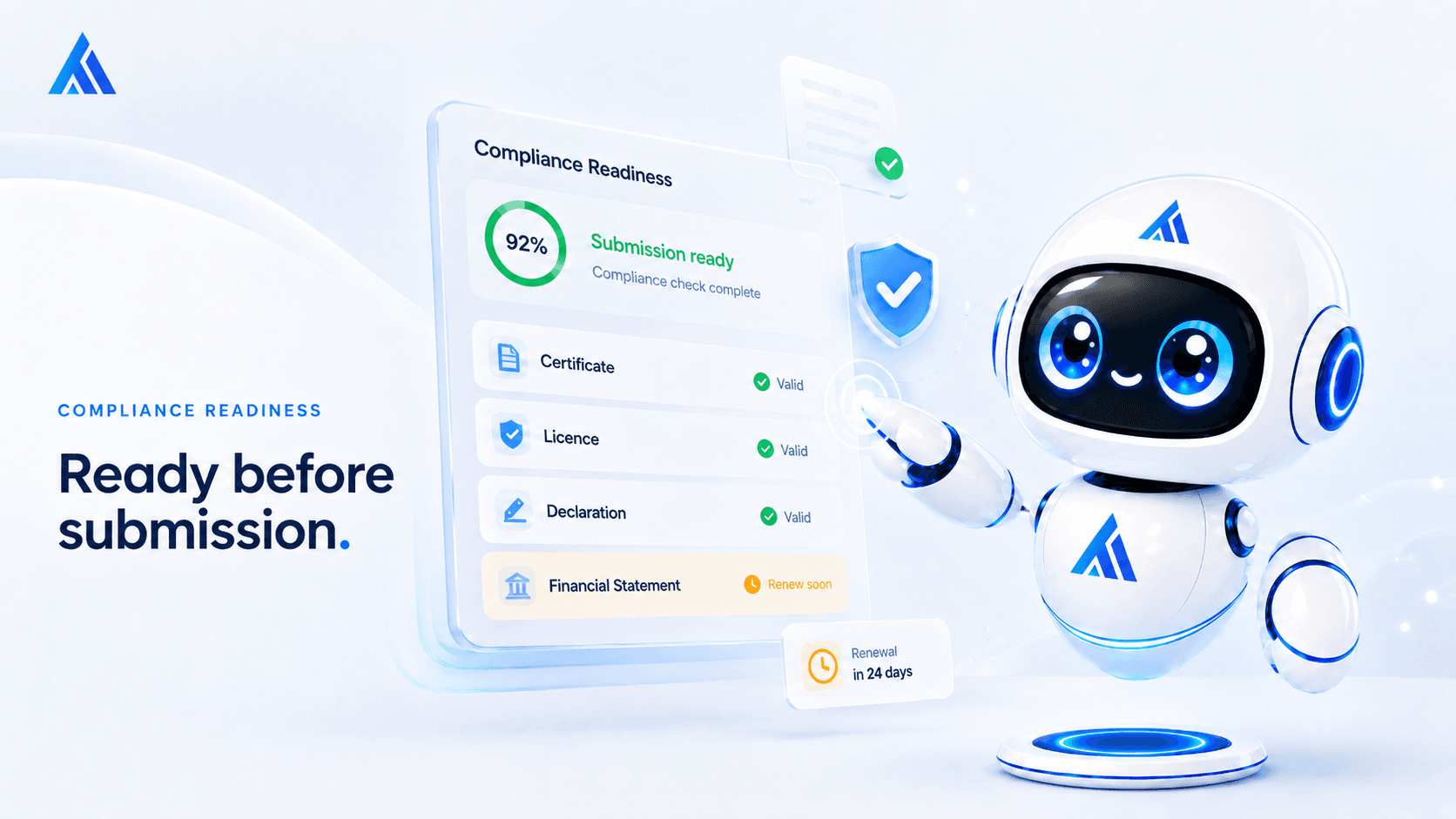
Once you decide to proceed, the platform runs a compliance checklist against the tender's stated requirements: things like mandatory attachments, response format rules, word or page limits, and declaration obligations that are easy to overlook when you're focused on writing persuasive content. Each item is trackable, so you can see what's outstanding as the bid progresses. When the response is ready, you can export the full compliance record alongside your submission documents, which means you have a clear audit trail if questions arise during evaluation or debrief. This is end-to-end bid management, not just a writing tool.
For Australian SMBs operating under the Commonwealth Procurement Rules or state-equivalent frameworks, demonstrating process rigour matters as much as the quality of your written response. Evaluators notice when submissions are incomplete or when mandatory criteria haven't been addressed, and those gaps are often grounds for automatic disqualification regardless Of how strong your Offer is. A compliance checklist that travels with your bid from assessment through to export is the difference between a submission that gets read and one that gets set aside on a technicality.
FAQs
How does the government procurement process work in Australia for small businesses?
Australian government procurement generally follows a structured cycle: a buyer publishes an approach to market (such as a Request for Tender or Request for Quote) on a platform like AusTender or a state equivalent, suppliers respond within the specified timeframe, and an evaluation panel assesses submissions against published criteria before awarding a contract. Commonwealth contracts above $80,000 (or $10,000 for some categories) must be advertised on AusTender, while states have their own thresholds and portals. SMBs should register on the relevant portals before an opportunity arises so they are ready to download documents immediately when a tender opens. Missing a registration step can cost you days Of a tight response window.
What are the most common tender evaluation criteria used by Australian government buyers?
Australian government tenders commonly score responses across three broad areas: demonstrated experience and capability, technical methodology or approach, and price. Weightings vary by agency and contract type, but it is common to see non-price criteria account for 60 to 80 percent Of the total score, meaning a low price alone will rarely win. Some tenders also include mandatory pass/fail criteria around insurance levels, licences, or financial viability that must be satisfied before your scored response is even read. Always download the evaluation matrix from the tender documents and map every section of your response directly to the published criteria weightings.
What compliance documents do Australian SMBs typically need to include in a tender response
Government tenders typically require evidence of public liability insurance (commonly $10 million or $20 million), professional indemnity insurance, and workers compensation coverage relevant to your jurisdiction. You will also commonly need to provide a current Australian Business Number, proof of any industry licences or certifications, and a signed deed of confidentiality or conflict of interest declaration. Some Commonwealth and state panels add requirements such as a modern slavery statement, a workplace health and safety management plan, or evidence of Indigenous procurement compliance. Prepare a compliance folder with current certificates and declarations so you can attach them quickly without scrambling near the deadline.
How should a small business manage the bid process during a live tender period?
As soon as you download tender documents, create a response plan that maps each requirement to a team member or task, with internal deadlines set at least 48 hours before the actual closing time. Treat any addenda or clarification notices issued by the buyer during the tender period as mandatory reading, since they can change scope, criteria, or pricing requirements and your response must reflect the final version Of the documents. Log all clarification questions through the official channel stated in the documents rather than contacting the buyer directly, because off-channel contact can disqualify your submission in some jurisdictions. Build your compliance checklist from the submission requirements section Of the RFT and tick it Off before you upload.
What procurement trends should Australian SMBs be aware Of when bidding for government work in the years ahead?
Australian governments at both federal and state levels are increasingly embedding social procurement requirements into contracts, including targets for Indigenous supplier participation, local content preferences, and commitments to employing apprentices or trainees. There is also a growing emphasis on cyber security capability, with agencies asking SMBs to demonstrate alignment with the Australian Cyber Security Centre's Essential Eight framework even for non-lT contracts. Panel arrangements and standing Offer deeds continue to dominate procurement, so winning a spot on a panel can generate ongoing work without repeated competitive tenders. SMBs that build these capability statements now will be better positioned as requirements tighten over the next one to two years.
How can an Al-powered tool like TenderAssist help SMBs improve their tender responses?
TenderAssist analyses the published evaluation criteria and response requirements from your tender documents, then helps you structure and draft each section so that your answer directly addresses what the evaluator is scoring. The platform includes a compliance checklist and export feature that flags mandatory attachments, insurance thresholds, and declaration requirements before you submit, reducing the risk of disqualification on a technicality. Because the tool is built around Australian government procurement language and common agency formats, the output aligns with the style evaluators expect rather than generic proposal writing. TenderAssist is designed to save you hours per tender on formatting and compliance checking alone, which matters when response windows are often only two to three weeks. See how TenderAssist builds compliance tracking into every stage Of your bid, from go/no-go through to final export