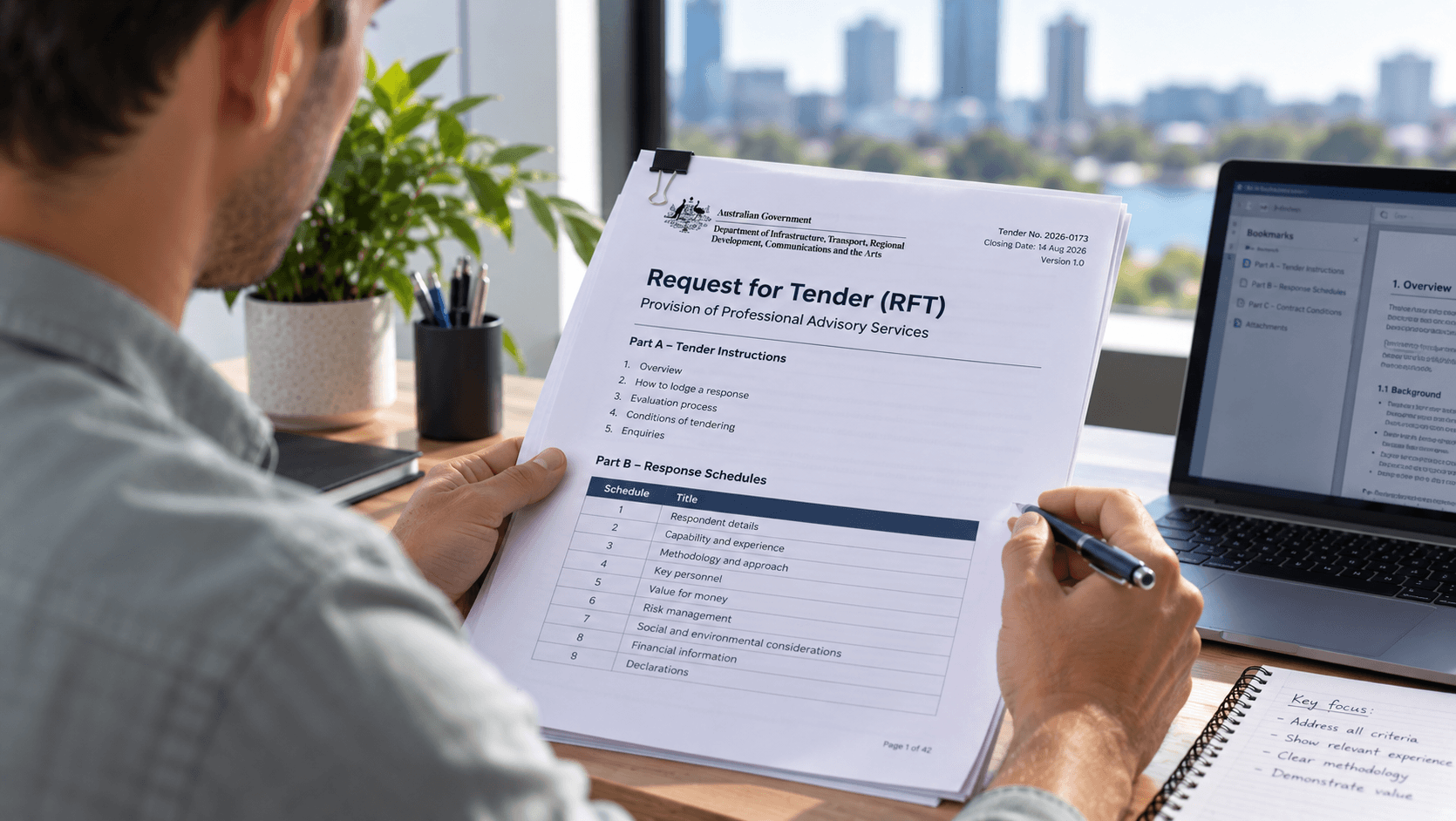
How Government Tenders Are Evaluated
When a government agency releases a Request for Tender, the evaluation panel is not simply looking for the cheapest price or the longest submission. They are assessing whether your business can solve a specific problem, deliver reliably, and reduce risk for the procuring agency. Understanding this buyer mindset is the foundation Of tender writing in Australia that actually wins work.
Every tender response should be framed around the agency's stated outcomes, not your company's history. TOO many small businesses spend the bulk Of their response talking about how long they have been in business or listing services they Offer, rather than directly addressing what the agency needs. Read the tender documents carefully and identify the key evaluation criteria: these are the sections you will be scored on, and your response structure should mirror them exactly.
Government evaluators often assess dozens of submissions under tight timeframes. A response that is easy to navigate, uses plain language, and directly answers each criterion will always perform better than a dense, jargon-heavy document. Write for a reader who may have no prior knowledge of your business and limited time to find the information they need.
How to Structure a Tender Response That Scores Well
A strong tender response structure fol lows the order and weighting of the evaluation criteria set out in the tender documents. Do not reorganise sections to suit your own preferences: evaluators score against a marking guide that maps directly to the criteria listed, so your response needs to make their job straightforward.
For each criterion, follow a clear three-part pattern: state your understanding of what is being asked, explain your specific approach or methodology, and provide evidence that demonstrates you have delivered similar outcomes before. Evidence can include case studies, named referees, certifications, past contract values, and measurable results. Vague claims like "we deliver quality outcomes" carry no weight without proof.
If the tender includes mandatory requirements, such as insurance thresholds, licences, or quality management certifications, address these first and confirm compliance explicitly. Failing a mandatory requirement means your submission is excluded regardless Of how strong the rest Of your response is. Once mandatory items are cleared, allocate your writing effort proportionally to the weighting assigned to each criterion. A criterion worth 40 per cent Of the total score deserves far more depth than one worth IO per cent.
Common Tender Writing Mistakes That Cost Small Businesses Contracts
One Of the most consistent mistakes in tender writing for small business is submitting a generic response that has been recycled from a previous tender. Evaluators can tell when a response has not been tailored to their specific requirements, and it signals that your business has not taken the opportunity seriously. Every tender warrants a fresh read of the documents and deliberate tailoring of your content.
Another frequent error is failing to answer the question that was actually asked. A criterion about your approach to risk management should be answered with your risk management methodology, not a paragraph about your company values or customer service philosophy. Stay disciplined and answer what is asked, then support it with evidence.
Other common mistakes that undermine otherwise capable businesses include: Submitting responses that exceed the specified word or page limits, which can result in automatic disqualification
using technical jargon or acronyms without explanation, assuming the evaluator shares your industry knowledge
Leaving pricing schedules incomplete or inconsistent with the rest of the response Missing the lodgement deadline, even by minutes, since government portals close submissions automatically once the deadline passes
Neglecting to proofread, leaving typographical errors that reduce your perceived professionalism
Best Practices for Tender Writing That Build a Long-Term Win Rate
Businesses that consistently win government tenders treat tender writing as a repeatable process, not a one-off effort. This starts with building a content library: a collection of pre-written, evidence-backed responses to common criteria such as work health and safety, quality assurance, environmental management, and relevant experience. Having reliable base content means you spend your time tailoring and improving rather than writing from scratch under deadline pressure.
Registering on government supplier portals such as AusTender at the federal level, or state equivalents like the NSW eTendering portal or VendorPanel, ensures you receive relevant opportunities as they are released Set up keyword alerts that match your service categories so you have maximum lead time to prepare a quality submission. A rushed tender written in 48 hours will rarely compete with one that has been developed over two weeks.
After each tender outcome, request a debrief from the agency regardless Of whether you won or lost. Many government agencies will provide a debrief if you request one, and this information is invaluable for understanding how your response was scored and what specific improvements to make. Businesses that seek and act on debrief feedback are well placed to improve their win rate over successive submissions.
Finally, be selective about which tenders you pursue. Bidding on every available opportunity drains resources and rarely pays Off. Assess each opportunity against your genuine capability to deliver, your existing relationships with the agency, and the competitiveness Of the field. Focusing your effort on tenders where you have a real advantage produces far better results than a high-volume, low-quality approach.
How TenderAssist's AI Drafting Checks Compliance and Keeps You Bid-Ready
Knowing best practice is one thing. Consistently applying it under pressure, across multiple bids, while running a business, is another challenge entirely. In our experience, small businesses don't usually lose tenders because they lack capability. They lose because a response missed a mandatory criterion, used the wrong word count, or failed to follow a formatting requirement buried on page fourteen Of the request documents. These are not strategic failures. They are process failures, and they are exactly what Al drafting is designed to prevent.
TenderAssist's Al drafting tool works directly from the tender documents you upload. It reads the rules, compliance requirements, and evaluation criteria specific to that opportunity, and structures your draft response around them, so mandatory requirements are represented in your draft from the start rather than added in as an afterthought. Before you apply, the platform also supports go/no-go decision-making, helping you assess whether a tender is a genuine fit for your business based on your capacity, experience, and the contract's requirements. That means you stop spending nights writing responses to opportunities you were never likely to win, and start directing your effort where it counts.
The compliance check layer sits underneath the drafting process the entire time. As your response takes shape, the tool flags gaps against the tender's stated requirements, such as missing attachments, unanswered criteria, and word limits that haven't been respected, so you can fix issues before you submit rather than discover them after the deadline. Government buyers score what they can see, and they disqualify what's incomplete.
Stop letting avoidable compliance gaps decide the outcome of your bids.
FAQs
What does tender writing in Australia actually involve for a small business?
Tender writing in Australia means preparing a formal written response to a Request for Tender (RET) or Request for Quote (RFQ) issued by a government agency at the federal, state, or local level. Your response must address every evaluation criterion in the tender documents, provide evidence of your capability and experience, and comply with any mandatory requirements around insurance, licences, or accreditations. For small businesses, this process often also involves pricing schedules, signed declarations, and sometimes capability statements. Getting all Of these elements right in a single submission is what separates businesses that win contracts from those that are marked non-conforming before evaluation even begins.
How do you structure a tender response to score well against evaluation criteria?
The most reliable structure is to address each criterion as its own clearly labelled section, using the exact wording from the RFT so evaluators can score your response without having to search for answers. Within each section, lead with a direct statement Of your capability or approach, then back it up with a specific example, quantified outcome, and a brief explanation of why that matters for this particular contract. Avoid grouping multiple criteria into a single long answer, as evaluators score each criterion separately and blended responses make their job harder. A common format is the Situation-Action-Result (SAR) method, which mirrors the same understanding-approach-evidence structure described above, and which Australian government tender evaluation panels are well used to reading
What are the most common tender writing mistakes that cause small businesses to lose?
The most damaging mistake is writing a generic response that could apply to any contract rather than one that speaks directly to the scope Of work, the agency's stated priorities, and the specific evaluation criteria. Other common errors include exceeding page or word limits, submitting responses with no supporting evidence, and failing to answer mandatory questions, which can result in automatic disqualification. Many small businesses also underestimate the importance Of the pricing schedule and submit figures without any accompanying narrative that justifies their costs. Spelling out your methodology and demonstrating value for money alongside your price gives evaluators confidence and protects your submission from being dismissed on cost alone.
How long does it take to write a government tender response in Australia?
A realistic timeframe for a mid-complexity government tender is two to four weeks from the moment the RFT is released, though many agencies give only ten to fifteen business days. The actual writing is only part of the work; you also need time to gather evidence documents, obtain referee contact details, prepare pricing schedules, and review the submission against the compliance checklist before lodging. Starting your response on day one of the release window, rather than the final week, is consistently one of the strongest predictors of a quality submission. using an Al drafting tool can compress the initial drafting phase significantly, freeing up your time for evidence gathering and review.
Do small businesses in Australia actually win government tenders against larger companies?
Yes, and government procurement policy actively supports this outcome. Many federal, state and local government buyers are required to consider value for money rather than lowest cost alone, which levels the playing field when a small business can demonstrate deep expertise, local knowledge, or faster delivery timelines. Many agencies also carry specific commitments to small and medium business participation in their procurement targets The key is writing a response that positions your size as an advantage rather than a limitation, emphasising direct principal involvement, agility, and a track record of delivering comparable work without the overhead of a large firm. Consistent, well-structured submissions over time also build your reputation with repeat buyers.
Can AI tools help with tender writing for Australian government contracts?
Al drafting tools can meaningfully reduce the time it takes to produce a first draft by structuring responses around evaluation criteria, suggesting relevant language, and prompting you to include evidence you might otherwise overlook. The most effective approach is to use Al to generate the initial framework and draft text, then layer in your specific project examples, real figures, and business-specific details that no tool can supply on its own. Australian government evaluators are experienced readers, so submissions still need to sound like they come from a business that understands the specific contract, not a template. Platforms built specifically for Australian tender writing, like TenderAssist, are designed to align Al output with local procurement language, evaluation frameworks, and compliance requirements.
See how TenderAssist's Al drafting helps you put together a well-structured bid, checked against the requirements, without the late nights